Week 6 of 6, Climate Work Residency
Disclosure as a service
How can Northwood answer climate questions from LPs (its investors) and buyers now, and keep doing it next year without Kith?
Highlights
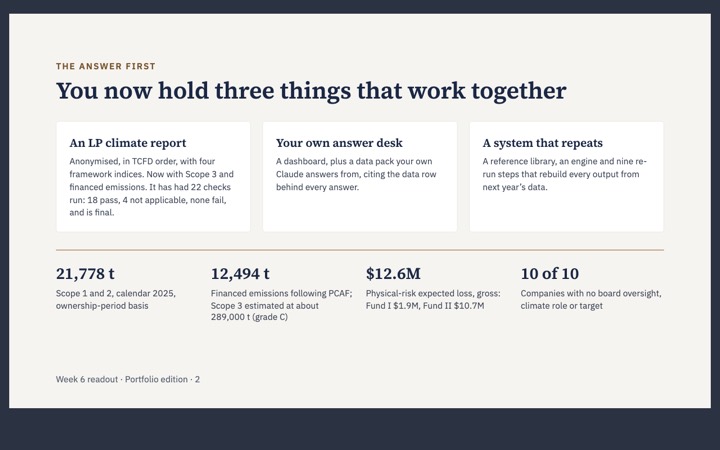
Readout deck, slide 2
The answer first: the three things delivered and the four headline figures.
Open (opens in a new tab)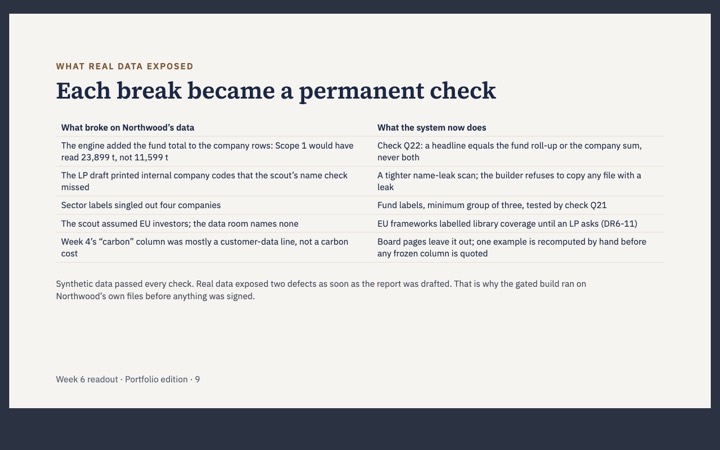
Readout deck, slide 9
What real data exposed: each failure on Northwood's data became a permanent check.
Open (opens in a new tab)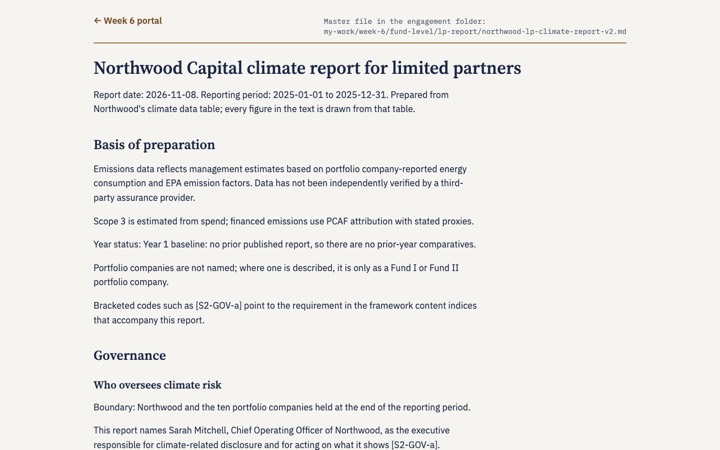
LP climate report
The anonymised report for limited partners, in TCFD order (the standard four-part climate-reporting structure), with the figures drawn from one data table.
Open (opens in a new tab)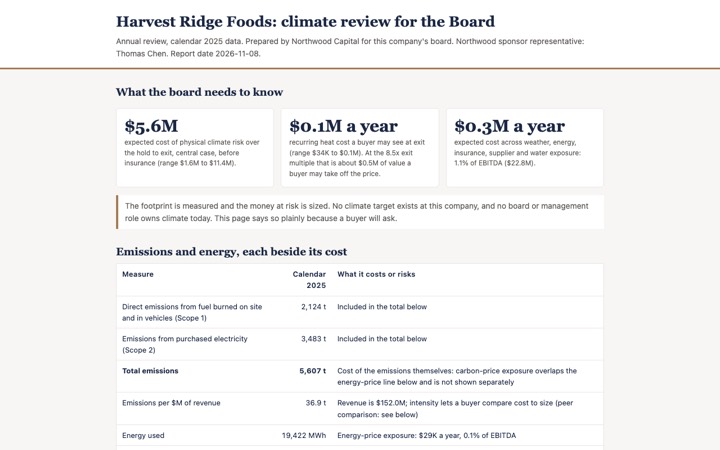
Harvest Ridge board page
One company's page for its own board: emissions beside cost, risk as a share of EBITDA (operating earnings), and what is missing, stated plainly.
Open (opens in a new tab)The case
Northwood needed a climate disclosure it could keep producing, not a one-off report. I delivered an anonymised LP report in TCFD order, a dashboard with a data pack Northwood's own AI assistant can answer from, a board page for each of the ten companies, and a library with nine re-run steps.
The headline: 21,778 t CO2e of Scope 1 and 2, about $12.6M of physical expected loss over the hold, and no company with board oversight, a climate role or a target. A buyer will ask about that last point, so the report says it plainly. Nothing has been sent to any LP; that stays Northwood's decision.
Which number is which: 21,778 t counts only the months Northwood owned each company (23,437 t for the full year). $12.6M is expected physical loss over each company's hold; Week 5 also gives it as $6.04M a year, plus an $18.2M stress case, and Week 4's $13.5M a year adds customer-revenue what-ifs.
All deliverables
Each opens in a new tab, in the Kith Climate style it was delivered in. Portal pages open with the path of their master file in the engagement folder, so the client can find the source behind each page.
- Week 6 portal (opens in a new tab)The entry page for every Week 6 deliverable, with audience tags.
- Readout deck (opens in a new tab)The close-out, with speaker notes.
- LP climate report (opens in a new tab)Governance, strategy, risk management, metrics and targets, with the aggregate data rows.
- Framework content indices (opens in a new tab)Requirements of the main climate-disclosure standards (IFRS S2, ESRS E1, SFDR PAI and ILPA EDCI), met or not, and where.
Show all 34
- QA result (opens in a new tab)The 22 quality checks run on the final report.
- LP report guide (opens in a new tab)How the report is made and rebuilt.
- Climate disclosure dashboard (opens in a new tab)Overview, companies, coverage and gaps, applicability and data requests.
- Query pack rules (opens in a new tab)The rules Northwood's own AI assistant follows: answer only from the files, cite the row.
- Dashboard guide (opens in a new tab)What each file is and how to rebuild.
- Board pages guide (opens in a new tab)The board-level rules, the page checks and what is open per page.
- Board page: Clearview Environmental Services (opens in a new tab)Fund II board page.
- Board page: Harvest Ridge Foods (opens in a new tab)Fund II board page.
- Board page: Keystone Behavioral Health (opens in a new tab)Fund II board page.
- Board page: Meridian Business Solutions (opens in a new tab)Fund I board page.
- Board page: NovaCare Health Partners (opens in a new tab)Fund I board page.
- Board page: Patriot Staffing Solutions (opens in a new tab)Fund II board page.
- Board page: Pinnacle Testing and Inspection (opens in a new tab)Fund II board page.
- Board page: Ridgeline Property Services (opens in a new tab)Fund II board page.
- Board page: Sterling Precision Manufacturing (opens in a new tab)Fund I board page.
- Board page: Trident IT Solutions (opens in a new tab)Fund I board page.
- Register guide (opens in a new tab)The files, the evidence map and the applicability answers, and how to re-run.
- Coverage matrix (opens in a new tab)Each concept against the framework requirements that need it.
- Data requests (opens in a new tab)The 16 requests: who is asked, for what, and why it matters.
- Engagement playbook (opens in a new tab)Eight stages, what the client gives at each, and the QA protocol.
- Framework freshness (opens in a new tab)Each framework by tier, how it was verified and when to check again.
- Framework notes (opens in a new tab)Status, pitfalls and defensible wording for each framework.
- Methodology notes (opens in a new tab)Materiality scoring, the data-quality rubric, anonymisation, and the Scope 3 and financed-emissions method.
- Applicability method (opens in a new tab)How the screen decides yes, no, unknown or monitor, and why a missing fact is never a no.
- Questions for counsel (opens in a new tab)Six questions on whether CSRD reaches a US private-equity structure.
- Process log (opens in a new tab)How the week ran, what worked and what did not.
- Week 1 reconciliation (opens in a new tab)Each Week 1 promise, what was delivered and the reason for any different route.
- Pricing reflection (opens in a new tab)Fixed versus per-company work.
- Re-run note (opens in a new tab)Nine commands that rebuild every output from next year's files.
- Hand-off notes (opens in a new tab)Actions handed to Northwood with owners, and the judgments to keep.
Data and method
The method notes, data and re-run steps that let the client reproduce the work without us.
- Readout deck (PDF) (opens in a new tab)PDF, 0.5 MBThe deck printed to PDF.
- Delivery lineage (opens in a new tab)CSVWhich source file each delivered page was built from.
How it was built
- One pipeline ran all ten companies. The register maps 32 concepts across four frameworks (352 evidence cells, 104 applicability answers) and lists 16 data requests, so a gap is shown, never counted as a no.
- The LP report passed 22 checks (18 pass, 4 not applicable in Year 1, none fail), and each check has a test that proves it can fail. A clean re-run from the pinned inputs alone rebuilds every final file identically.
- Real data exposed two defects the synthetic test data had hidden: the engine added the fund total to the company rows (which would have roughly doubled reported Scope 1), and the draft printed internal company codes. Each became a permanent check.
- Reviewers raised 41 findings over two rounds, 12 of them must-fix. 40 were fixed. Scope 3 (about 289,000 t, grade C) is a spend-based estimate and is not added to Scope 1 and 2.
- In the portfolio review I re-read the framework statuses: 16 of 48 requirements were marked met as delivered, and 9 hold on review. Both counts are shown, and no figure changed.
My part
- I decided that the LP report is anonymised and the dashboard is named for Sarah Mitchell, Northwood's COO (fictional), and chose a static dashboard plus query pack as the real leave-behind.
- I ruled that departing from a Week 1 promise was fine if the reason is explained, and the process log does that for each departure.
- I named Sarah Mitchell as the responsible executive in the governance section, and set the Scope 3 and financed-emissions approach at close-out.
- I held pricing to the end, and approved the framework tiers.
The AI's part
- Claude, working in a blank sandbox first, built a generic disclosure library, which was then applied to Northwood's data.
- Claude built the engine, the LP report, the dashboard and query pack, the ten board pages and the QA checks.
- Claude ran the reviewers. They caught a claim that the model was checked against company events before use, when in fact five of nine passed first time, and a decision credited to Northwood that was mine. Both were corrected.
- Two separate Claude sessions tested the query pack cold and found nine gaps.
Across the engagement
From Week 5. Week 5 supplied the physical-risk expected loss over the hold and its method; Week 3 supplied the emissions; Week 4's exposure model supplied each board page's risk as a share of EBITDA. Recomputing one Week 4 column by hand showed it was mostly a customer-data line, not a carbon cost, so the board pages leave it out.